
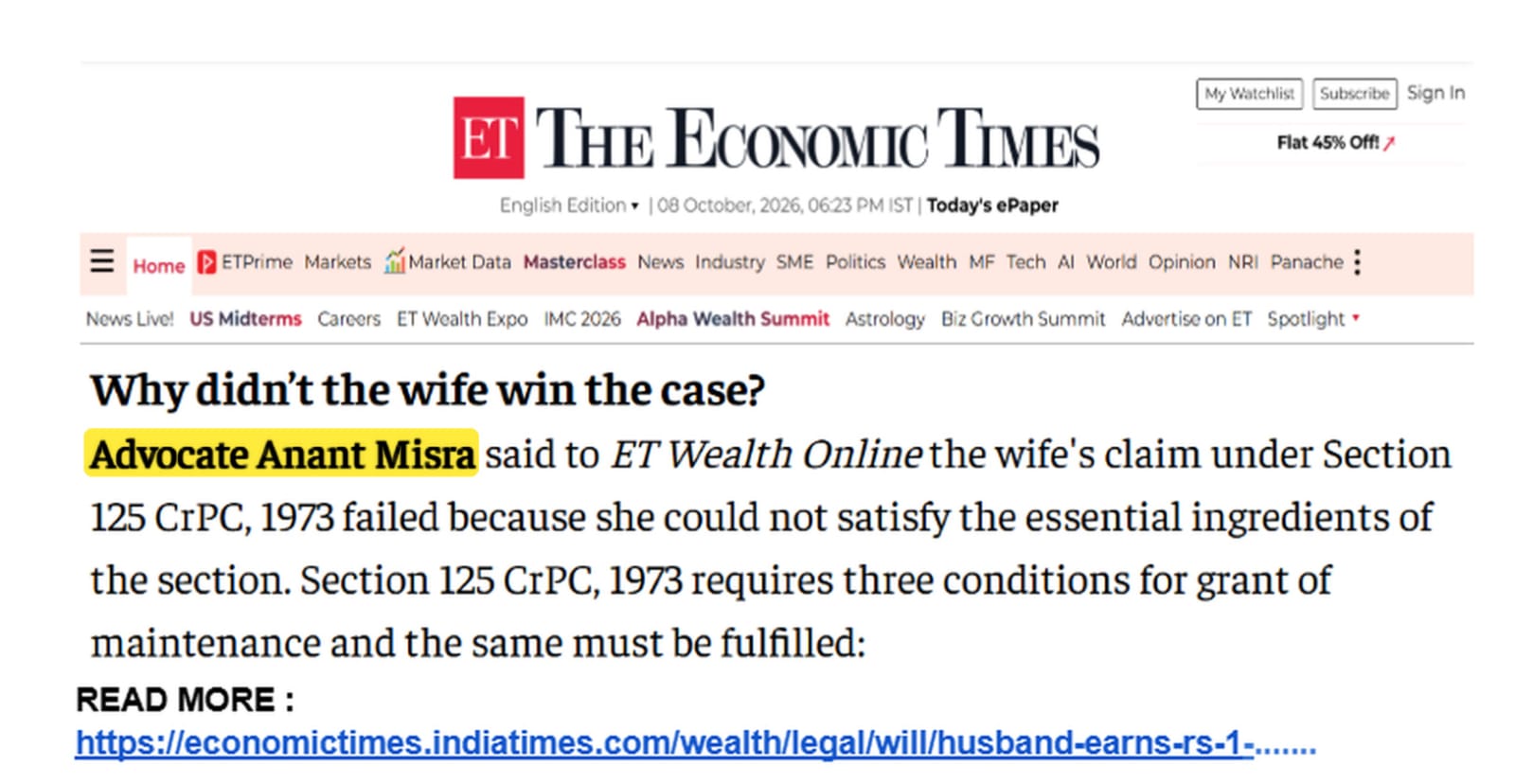
Short answer: A wife can be denied maintenance when she is able to maintain herself, when she refuses to live with her husband without sufficient reason, when she is living in adultery, or when the couple lives apart by mutual consent. His high income does not decide eligibility; it only decides how much can be ordered. The provision is now Section 144 of the BNSS (earlier Section 125 CrPC). A recent Allahabad High Court ruling, reported by ET Wealth on 8 October 2026, shows how these tests work in practice.
As reported by The Economic Times (ET Wealth), a wife sought maintenance from her husband, who was said to earn about Rs 1.5 lakh a month. The Family Court rejected her claim. It found that she was well educated and capable of earning, that she had left the matrimonial home soon after the marriage, and that her husband had made efforts to bring her back, which she declined. In revision, the Allahabad High Court refused to disturb that decision, observing that the findings were factual, based on evidence, and showed no illegality or perversity.
The case is a useful reminder that maintenance is not automatic, even when the husband earns well. Two questions decided the outcome: was the wife genuinely unable to maintain herself? and did she have sufficient reason to stay away?
For anyone searching for the law on wife maintenance in Delhi, the first thing to know is the renumbering. From 1 July 2024, Section 125 of the Code of Criminal Procedure has been replaced by Section 144 of the Bharatiya Nagarik Suraksha Sanhita (BNSS), 2023. The purpose is unchanged: to prevent vagrancy and destitution by making a person with sufficient means support dependants who cannot support themselves.
Cases that were already pending before 1 July 2024 continue under the old Code, which is why news reports on older matters, like the Allahabad ruling above, still speak of Section 125 CrPC. A fresh application filed today in a Delhi Family Court is made under Section 144 BNSS.
The section covers more than wives. A Magistrate can order a monthly allowance, with no fixed upper cap, in favour of the following persons if they cannot maintain themselves and the person against whom the claim is made has sufficient means.
| Who can claim | Key condition | Practical point |
|---|---|---|
| Wife | Unable to maintain herself; husband neglects or refuses to maintain her | Includes a divorced wife who has not remarried |
| Children (legitimate or illegitimate) | Unable to maintain themselves; minor, or an adult with a physical or mental abnormality or injury | Married daughters are excluded once they are adults |
| Father or mother | Unable to maintain themselves | Claim is against the son or daughter with sufficient means |
Alongside the main claim, the Magistrate can grant interim maintenance and reasonable litigation expenses while the case is pending. The law expects an interim application to be disposed of within 60 days of notice to the other side, although in busy courts this can take longer.
If any one of these links is missing, the claim can fail. In the Allahabad case, the court was not satisfied on the fourth point and the question of sufficient reason for living apart.
Apart from failing the basic conditions above, the law itself lists situations in which a wife is not entitled to a maintenance allowance (Section 125(4) CrPC, now Section 144(4) BNSS).
| Ground | What it means | What decides it |
|---|---|---|
| Able to maintain herself | She earns or can support herself reasonably | Proof of actual income, assets and employment history |
| Living in adultery | She is in a continuing adulterous relationship | Strong, reliable evidence; one past act is usually not enough |
| Refusing to live with husband without sufficient reason | She stays away although he is willing to keep her | Whether her reasons (cruelty, dowry demands, ill-treatment) are genuine |
| Living separately by mutual consent | Both agreed to live apart | Clear evidence of the agreement |
If a husband proves one of these grounds later, he can ask the court to cancel or modify an existing order. Likewise, a change in either side's circumstances, such as a job loss or a real increase in income, can lead to a revision of the amount.
No, not merely because she is qualified. The Supreme Court explained in Chaturbhuj v. Sita Bai (2008) that a wife need not be absolutely destitute to claim maintenance; if her own income is not enough for a reasonable living, she can claim even if she earns something. The courts therefore look at actual ability, not at degrees on paper.
At the same time, a wife who is genuinely earning enough, or who is shown by evidence to have a real capacity to earn and is deliberately staying idle, can be refused maintenance, as the Allahabad High Court's ruling shows. Courts weigh her qualifications, work history, current offers and the standard of living she would have had in the matrimonial home.
For wives: the decisive word in this section is "unable". Do not assume that being qualified will count against you, but do not hide income either. Explain honestly why you left, document cruelty, dowry demands or ill-treatment with messages, medical records and complaints, and file for interim maintenance early. A claim with a clear reason for living apart is far stronger than one without it.
For husbands: a high salary does not shield you from a claim, and a low-effort defence rarely works. Show your efforts to reconcile (notices, calls, offers to take her back) and bring real evidence of the wife's income or earning capacity. Courts decide on proof, not on assumptions about what an educated spouse should be doing.
For both sides: the Family Court is the stage where the facts are decided. A High Court in revision rarely reopens findings of fact, so the evidence you place before the trial court matters most.
His income affects the amount, not the eligibility. In Rajnesh v. Neha (2020), the Supreme Court laid down that both spouses must file a full affidavit of their income, assets and liabilities, and that courts should consider factors such as the couple's standard of living, the wife's reasonable needs, her education and earning capacity, the husband's other liabilities, and the needs of the children. Maintenance is generally payable from the date of the application.
For a closer look at how courts arrive at figures, read our guide on calculating alimony and maintenance in Delhi and our explainer on who can claim maintenance in India.
A refusal under Section 144 BNSS does not close every door. The Hindu Marriage Act allows a spouse to seek interim maintenance (Section 24) and permanent alimony (Section 25) in the matrimonial case itself, and the Domestic Violence Act, 2005 provides monetary relief to a woman facing domestic violence. These follow different tests, so the result in one proceeding does not automatically decide the others. If domestic violence is part of the story, see our page on the domestic violence lawyer in Delhi.
Maintenance is often one issue among many in a marriage breakdown, along with custody and the route to divorce. Our pillar guide to the best divorce lawyer in Delhi explains how these pieces fit together, and our article on how long a divorce case takes in Delhi courts covers the timeline.
| Step | What happens | Tip |
|---|---|---|
| 1. Case review | The advocate checks marriage proof, income evidence, the reason for separation and prior communication | Collect messages, medical records and bank statements early |
| 2. Filing | The application is filed in the Family Court or Magistrate with jurisdiction (for example Tis Hazari, Patiala House, Rohini or Dwarka) | Jurisdiction depends on where either spouse lives or last lived together |
| 3. Interim maintenance | An application for interim maintenance and litigation costs is argued while the case runs | File it together with the main application |
| 4. Affidavits of assets | Both sides disclose income, assets and liabilities as required by Rajnesh v. Neha | An incomplete or false affidavit can damage credibility |
| 5. Evidence and arguments | Witnesses and documents are examined; the court decides on means, inability and sufficient reason | This stage decides the case; revision rarely changes findings of fact |
| 6. Order and enforcement | The court fixes a monthly amount; unpaid sums can be recovered through coercive steps, and imprisonment for default is possible | Either side can later seek modification if circumstances change |
Delhi has dedicated courts for each of these areas. If you are in North or Central Delhi, our pages on the divorce lawyer at Tis Hazari Court and the divorce lawyer at Rohini Court cover how matters proceed at those courts.
The Allahabad ruling is a decision on its own facts, not a rule that educated wives cannot claim maintenance. Its practical lesson is about evidence: why a spouse left, whether the other side tried to reconcile, and what each side truly earns. Whether you are seeking maintenance or defending a claim, a clear record built early gives the court something concrete to rely on.
AM Legal, Delhi, advises both wives and husbands in maintenance, alimony and divorce matters. To discuss your situation, visit the AM Legal homepage or learn more about Advocate Anant Misra.
No. Section 125 CrPC has been replaced by Section 144 of the Bharatiya Nagarik Suraksha Sanhita (BNSS), 2023, which came into force on 1 July 2024. The core test is the same. Proceedings that began before that date generally continue under the old Code.
Yes. The law asks whether she is actually unable to maintain herself, not whether she holds a degree. If her real income cannot support a reasonable standard of living, she can still claim. If she is earning enough, or has a clear and proven capacity to earn, the court can refuse or reduce maintenance.
It depends on why she left. If she refuses to live with her husband without sufficient reason, the court can deny maintenance. If she left because of cruelty, dowry demands or other genuine causes, that is a sufficient reason and her claim stays alive.
No. His income decides how much maintenance can be ordered, not whether the wife is eligible. She must still show that she cannot maintain herself and that she has not lost the right under the statutory exceptions.
A wife is not entitled to maintenance if she is living in adultery, if she refuses to live with her husband without sufficient reason, or if they are living separately by mutual consent. The court can also cancel an existing order if these grounds are proved later.
She may have other remedies with separate tests, such as interim maintenance and permanent alimony under Sections 24 and 25 of the Hindu Marriage Act, or monetary relief under the Domestic Violence Act, 2005. The outcome in one forum does not automatically decide the others, although findings of fact can be relied on.
This article is general legal information based on publicly reported news and does not constitute legal advice. For advice on your case, please consult Advocate Anant Misra.